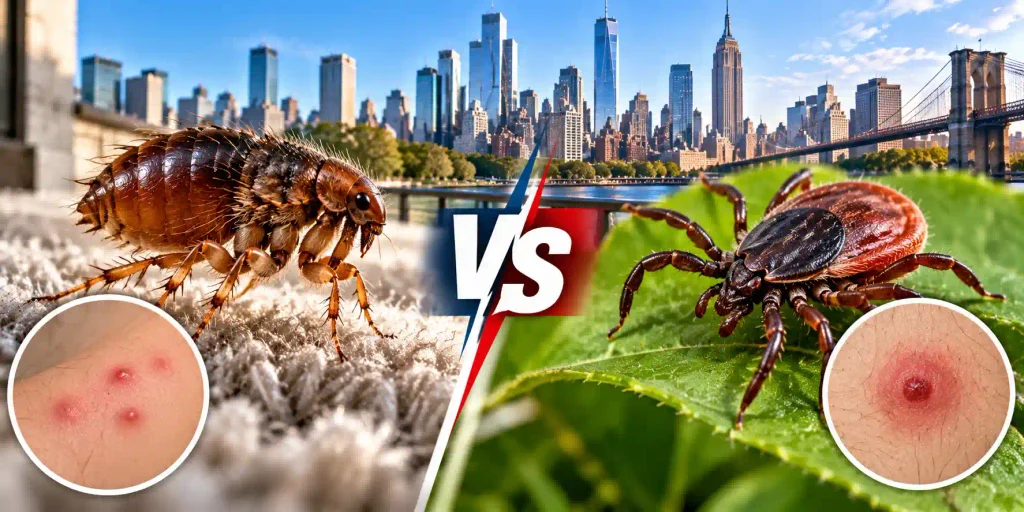
Finding a tiny, dark pest on your pet, clothing, furniture, or skin can immediately raise a question: Is it a flea or a tick? Although both are small blood-feeding pests, fleas and ticks are very different in how they look, move, live, and become a problem.
Understanding flea vs tick Manhattan differences is especially useful for apartment residents, pet owners, property managers, and anyone who spends time outdoors. Fleas can become established inside homes, particularly around pets, bedding, rugs, upholstered furniture, and floor edges. Ticks, on the other hand, are more closely associated with outdoor exposure in grassy, brushy, wooded, or leaf-covered areas.
The local context matters too. NYC Health says several types of ticks have been found within New York City, although many NYC residents diagnosed with tick-borne illnesses were exposed while visiting grassy or wooded areas outside the city. This guide explains the difference between fleas and ticks, what their bites and infestation signs can look like, where to search for them, and when professional pest control may be worth considering.
Fleas vs Ticks in Manhattan: Quick Comparison
At first glance, fleas and ticks may both appear to be tiny dark pests. A closer look reveals major differences.
Fleas are insects. Adult fleas are wingless and have six legs. They are built for jumping and commonly feed on animal hosts, although they can bite people as well. Ticks are arachnids rather than insects. Adult ticks have eight legs and typically reach a host by waiting in suitable outdoor vegetation and grabbing onto a passing person or animal.
Their movement is another useful clue. A flea can jump quickly when disturbed. A tick does not jump or fly; it crawls and may attach itself to the skin to feed.
Here is a simple comparison:
| Feature | Fleas | Ticks |
| Classification | Insect | Arachnid |
| Adult legs | 6 | 8 |
| Movement | Jump and crawl | Crawl |
| Common exposure | Pets and indoor environments | Grassy, brushy or wooded areas |
| Feeding | Blood | Blood |
| Indoor infestation | Can develop through multiple life stages | Usually different from a typical flea-style indoor infestation |
| Common clue | Jumping flea or flea dirt | Tick attached to skin |
| Key concern | Ongoing flea life cycle indoors | Tick bite and potential disease exposure |
Knowing these basic differences can make the next inspection much easier.
How to Identify Fleas and Ticks
Correct identification should come before treatment. Using Tick Removal Service NYC without knowing what pest you are dealing with can waste time and may allow the problem to continue.
What Does a Flea Look Like?
Adult fleas are very small, wingless insects. Their bodies are flattened from side to side, helping them move through animal fur. Their powerful hind legs allow them to jump.
You may notice fleas around:
- pet bedding and sleeping areas
- rugs and carpeting
- upholstered furniture
- floor edges and baseboards
- areas where pets regularly rest
Another clue is flea dirt—small dark specks associated with flea activity.
The CDC explains that fleas survive by feeding on animal or human blood and that adult fleas locate hosts using cues including movement, body heat, vibrations, and breathing. If you suspect an infestation but have not clearly identified the pest, check Best@Pest’s guide to Signs of Fleas in House for additional indicators.
What Does a Tick Look Like?
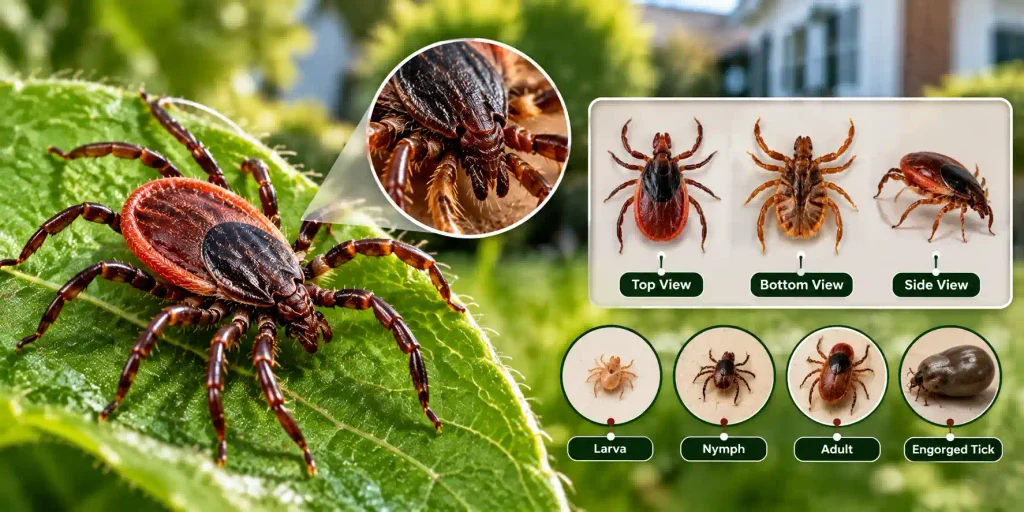
Ticks are arachnids. Adults have eight legs and may vary in size and appearance according to species and life stage. A feeding tick can also become noticeably larger as it takes a blood meal.
Unlike fleas, ticks do not leap across a carpet or jump from vegetation. NYC Health explains that ticks wait for a person or animal to pass, grab onto the host, and then crawl to a suitable place to attach and feed. After outdoor activity, check yourself, children, and pets carefully. NYC Health specifically recommends examining areas such as behind the ears and knees, around the waist, in the hairline, between the legs, and other skin folds.
Flea Bites vs Tick Bites: What Is the Difference?
Bites alone are not always enough to identify a pest. Skin reactions vary from person to person, and different pests can produce similar-looking irritation.
Still, there are some useful distinctions.
Flea bites can cause itching and irritation. They may be noticed on exposed skin, and the CDC specifically notes that flea bites often occur around the lower legs and feet.
A tick behaves differently. Instead of repeatedly jumping onto a host, it can attach itself to the skin and remain there while feeding. Finding the actual attached tick is therefore a particularly important clue.
Do not rely only on the appearance of a bite to diagnose the pest. Look for supporting evidence in the home, on pets, on clothing, or on the skin.
If you develop concerning symptoms following a suspected flea or tick bite, contact an appropriate healthcare professional. Pest identification and medical diagnosis are different issues.
Signs of Flea Infestation in a Manhattan Apartment
A flea infestation Manhattan residents encounter may not begin with seeing dozens of adult fleas. Early signs can be subtle.
You may first notice unusual pet scratching, small jumping insects, flea dirt, or bites around the ankles and lower legs. Checking the areas where pets spend the most time can provide additional clues for Flea Control Service NYC. Fleas are particularly difficult to manage because the visible adults are only one part of their life cycle.
The flea life cycle includes four stages:
Egg → Larva → Pupa → Adult
CDC guidance explains that the pupal stage is protected inside a cocoon and that adults can emerge in response to signs of a nearby host, including movement and body heat.
This is one reason simply killing the adult fleas you see may not solve an established infestation.
In a Manhattan apartment, inspect around pet resting areas, carpeting, rugs, upholstered furniture, floor edges, and other places where pets regularly spend time.
Best@Pest already has a detailed resource covering Signs of Fleas in House, including common areas to inspect.
Signs of Tick Activity
A tick infestation Manhattan search can be somewhat misleading because ticks and fleas behave differently.
Ticks are primarily an outdoor exposure concern. CDC guidance identifies grassy, brushy, and wooded areas as common tick habitats, while NYC Health says ticks prefer cooler areas with trees, brush, leaf litter, and tall grass that provide shade.
Possible signs of tick exposure include finding:
- a crawling tick on clothing
- a tick attached to a person
- ticks on a dog or other pet after outdoor activity
- ticks after time in suitable outdoor habitat
Pets can also transport ticks. CDC recommends checking pets that go outdoors daily, particularly after they have spent time in tick habitat.
For Manhattan residents, checking after outdoor recreation or trips beyond the borough is especially sensible.
Where Do Fleas Come From in Manhattan Homes?
Pets are an important flea host, but assuming fleas can occur only in homes with pets is a mistake.
Fleas prefer animal hosts, but people can be bitten when they share space with an infested animal. Wildlife and stray animals can also carry fleas.
Once introduced into an indoor environment, eggs and developing flea stages can become associated with the places an animal spends time.
That can include:
- pet beds
- rugs
- carpets
- sofas
- upholstered furniture
- cracks near flooring
- floor and wall edges
For Manhattan apartments, the important question is therefore not simply, “Where did I see the flea?” It is, “Where is the flea life cycle continuing?”
That distinction can determine whether cleaning one small area is enough or whether a more complete inspection is needed.
Where Are Ticks More Likely to Come From?
Ticks have a different exposure pattern.
NYC Health reports that ticks are most active during spring, summer, and fall and occur in habitats with vegetation, leaf litter, brush, and shade. The agency also notes that ticks capable of carrying disease-causing germs occur in parts of NYC, while many NYC residents diagnosed with tick-borne illness were infected after visiting grassy or wooded areas in upstate New York, Long Island, or surrounding states.
A Manhattan resident may therefore encounter a tick after activities such as hiking, walking through brush or tall grass, visiting a wooded property, traveling with a pet, or spending time in another tick habitat.
In June 2026, the NYC Health Department specifically highlighted Staten Island, the North Bronx, and wooded areas outside NYC including Long Island, upstate New York, New Jersey, and Connecticut as important areas for tick-bite prevention.
That makes your recent outdoor activity an important clue when trying to distinguish fleas from ticks.
How to Get Rid of Fleas in a Manhattan Apartment
If fleas have become established indoors, focus on the entire life cycle rather than only the adult insects you can see.
The CDC recommends a coordinated approach involving sanitation, treatment of pets, treatment of the home when necessary, and follow-up.
Start With Thorough Cleaning
Vacuum areas where fleas or developing stages may be present. Pay particular attention to carpeting, rugs, upholstered furniture, floor edges, and pet resting areas.
Wash appropriate bedding and pet bedding according to their care instructions.
Vacuuming should not be treated as a one-time fix. Ongoing cleaning can help remove fleas and developing stages while the infestation is being addressed.
Address Pets at the Same Time
If you have a dog or cat, treating the property while ignoring an infested pet can allow the cycle to continue.
Talk with your veterinarian about an appropriate flea-control product for your animal. The CDC recommends keeping pets protected and following product directions.Never assume a pest-control product intended for the home is suitable for direct application to an animal.
Inspect More Than the Area Where You Saw a Flea
Seeing one flea on a sofa does not necessarily mean the problem exists only on that sofa.
Check areas where the pet sleeps, rests, or spends significant time. This helps determine the extent of activity before choosing a control strategy.
Consider Professional Flea Control
A persistent infestation may require professional flea control Manhattan NY residents can use alongside sanitation and appropriate veterinary care.
Best@Pest’s verified website currently lists professional flea control for residential, apartment, and commercial properties in NYC and describes inspections of areas including floor coverings, pet sleeping areas, baseboards, and furniture. Best @ Pest NYC
A flea exterminator Manhattan property owner contacts should first identify where activity is occurring and determine an appropriate treatment plan rather than treating every area in exactly the same way.
What Should You Do If You Find a Tick?
Finding an attached tick requires a different response from discovering fleas in a carpet.
Remove an attached tick promptly and correctly. NYC Health says that quickly removing an attached tick lowers the chance of getting sick from the bite. After spending time in a potential tick habitat, check your body, clothing, children, and pets.
CDC prevention guidance also recommends avoiding brushy and wooded areas with tall grass and leaf litter when possible, walking in the center of trails, and using appropriate tick-bite prevention measures. If you have a yard or outdoor property, habitat management may also help. NYC Health recommends measures such as keeping grass short, reducing brush and leaf piles, and allowing more sunlight into suitable areas. If ticks repeatedly occur around a property, tick control Manhattan NY may require assessment of the outdoor environment rather than an indoor flea-style treatment.
DIY vs Professional Flea and Tick Control Manhattan
DIY measures can be useful when the pest has been correctly identified and activity is limited.
For fleas, regular vacuuming, laundering appropriate bedding, pet care, and monitoring can all play useful roles. For ticks, personal protection, body checks, pet checks, and outdoor habitat management are more relevant.
However, professional assistance becomes worth considering when you continue seeing fleas after cleaning, multiple rooms show activity, you cannot locate the source, the infestation repeatedly returns, or ticks are consistently being encountered around an outdoor property.
Professional pest control for fleas and ticks Manhattan properties need should begin with correct pest identification because flea and tick control are not interchangeable.
Best@Pest currently lists NYC flea control among its services, and its Manhattan service page confirms that the company serves residential and commercial pest-control customers in Manhattan.
How to Prevent Fleas in Your Manhattan Home
Prevention is easier when you understand how fleas reach and remain in a property.
Regularly check pets for fleas and discuss suitable preventive products with your veterinarian. CDC guidance notes that dogs and cats are susceptible to fleas and recommends regular checks and veterinarian-guided flea prevention.
Keep pet sleeping areas clean. Vacuum carpets, rugs, furniture cushions, and other areas pets frequently use.
Pay attention when an animal begins scratching more than usual. Increased scratching does not prove fleas are present, but it is a reason to inspect the animal and surrounding areas.
Finally, do not ignore a confirmed flea simply because you saw only one. Early investigation and Pest Control Services in Manhattan can help determine whether it was an isolated introduction or evidence of a developing indoor population.
How Manhattan Residents Can Reduce Tick Exposure
Tick prevention starts before exposure.
The CDC recommends knowing where ticks live, avoiding contact with tall grass and leaf litter when practical, and using appropriate EPA-registered repellents. Clothing and gear can also be treated with products containing 0.5% permethrin according to directions.
After outdoor activity, inspect yourself carefully. Also inspect children and pets.
NYC Health recommends showering within two hours after coming indoors because this can help wash off unattached ticks and make attached ticks easier to find.
For dog owners, daily tick checks after outdoor exposure are particularly useful. Look carefully around the ears, eyelids, collar, legs, toes, and tail area.
Flea vs Tick Manhattan: When Should You Call an Exterminator?
You do not necessarily need professional treatment every time you see an unfamiliar insect or arachnid.
First, try to identify it.
For fleas, professional help becomes more relevant when repeated cleaning and appropriate pet management are not stopping activity, fleas are appearing across multiple rooms, or you continue getting bites and finding live fleas.
For ticks, professional pest management may be appropriate when ticks are repeatedly being found around a property with suitable outdoor habitat or when you need help identifying and reducing environmental conditions that support them.
A professional inspection can help answer three practical questions:
What pest is present? Where is it coming from? What control method actually fits the problem?
That approach is more useful than automatically spraying an apartment because a small dark pest was found.
For Manhattan residents and businesses dealing with an ongoing pest problem, Best@Pest Exterminating’s verified Manhattan page provides local pest-control service information. Best @ Pest NYC
Fleas and Ticks Require Different Control Strategies
The biggest lesson from the fleas vs ticks in Manhattan comparison is simple: they should not be treated as the same problem.
Fleas can develop through eggs, larvae, pupae, and adults within an indoor environment. Effective management therefore often combines cleaning, pet management, monitoring, home treatment when appropriate, and follow-up.
Ticks are more strongly connected with outdoor exposure. Prevention centers on avoiding or managing suitable habitat, using personal protection, checking people and pets after outdoor activity, and promptly removing attached ticks.
Correct identification should always come first.
If you are seeing jumping insects around carpets or pet bedding, investigate for fleas. If you find an arachnid crawling on you after outdoor activity or attached to the skin, a tick becomes more likely.
And when the evidence is unclear, professional identification can prevent you from treating the wrong pest.
FAQs About Fleas vs Ticks in Manhattan
Are fleas and ticks the same thing?
No. Fleas are insects, while ticks are arachnids. Adult fleas have six legs and can jump. Adult ticks have eight legs and crawl. Their life cycles, behavior, habitats, and control strategies are also different.
Can fleas live in a Manhattan apartment without pets?
Yes. Although pets are important flea hosts, fleas can be associated with other animal hosts and may remain in an indoor environment after being introduced. CDC guidance notes that fleas prefer animal hosts but can bite people as well.
Can ticks be found in New York City?
Yes. NYC Health states that several types of ticks have been found in New York City. However, many NYC residents diagnosed with tick-borne diseases were exposed in grassy or wooded locations in surrounding regions.
Do fleas jump while ticks crawl?
Yes. Jumping is one of the easiest behavioral clues for distinguishing the two. Fleas have powerful legs adapted for jumping. Ticks crawl and attach to passing hosts rather than jumping or flying.
What are the most common signs of a flea infestation?
Common clues include live jumping fleas, flea dirt, bites, increased scratching in pets, and activity around pet bedding, rugs, carpets, furniture, or other areas animals frequently use. Because fleas have several life stages, seeing adult fleas may represent only part of the problem.
Should I call professional pest control for fleas or ticks in Manhattan?
Consider professional help if you cannot identify the pest, flea activity continues despite cleaning and appropriate pet care, an infestation affects multiple areas, or ticks repeatedly occur around an outdoor property. Best@Pest Exterminating currently provides pest-control services in Manhattan and lists professional flea control among its NYC services. Best @ Pest NYC
Need Help Identifying Fleas or Ticks in Manhattan?
A small pest problem is much easier to address when you know exactly what you are dealing with. Look at the pest’s body, movement, location, possible host, and where you first noticed activity.
If fleas continue appearing in your apartment or business, or you are unsure what pest is causing the problem, a professional inspection can help identify the source and determine an appropriate control approach.
Best@Pest Exterminating serves Manhattan as part of its NYC pest-control coverage. For an ongoing infestation, contact the company to discuss the problem and available service options.