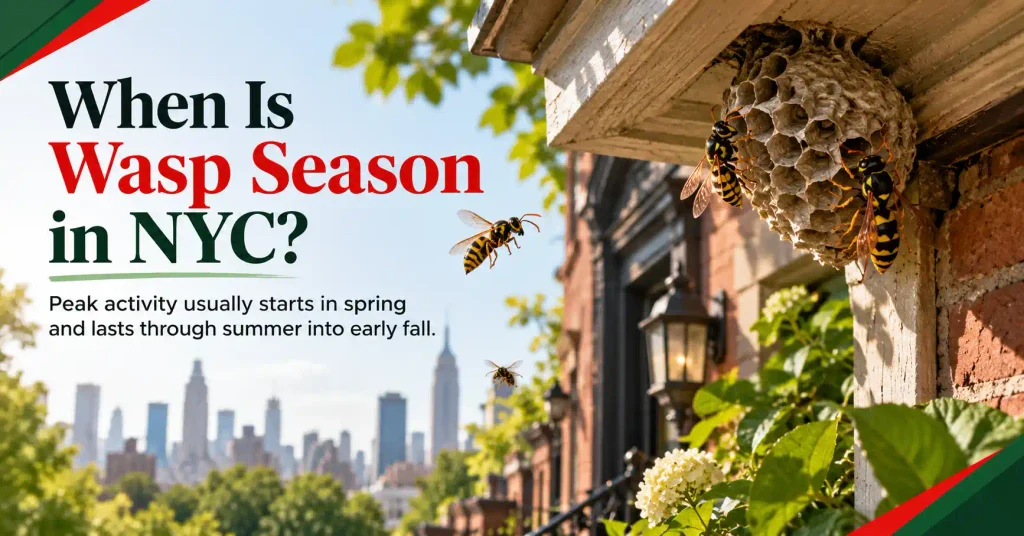
If you have started seeing more wasps around your roofline, backyard, storefront, trash area, or outdoor seating space, you may be asking When Is Wasp Season in NYC? The short answer is that wasp activity usually begins in spring, increases through summer, and becomes most noticeable from late summer into early fall. The exact timing can shift with temperature, food availability, nesting conditions, and the species involved.
New York City has several social wasps in the family Vespidae, including Yellowjackets, Paper Wasps, and Bald-Faced Hornets. German Yellowjackets and Eastern Yellowjackets are especially important around buildings because they can establish colonies in structural voids, ground cavities, and other protected spaces. Cornell IPM notes that Eastern Yellowjacket colonies are active in the Northeast from roughly May through September, while social wasp colonies generally build in size as the warm season progresses.
For homeowners, landlords, business owners, property managers, restaurants, and other commercial properties, understanding the seasonal cycle makes it easier to spot a developing problem before a nest becomes large. This guide explains the NYC timeline, where wasps nest, why late summer can be more difficult, how weather affects activity, and when professional help makes sense.
Quick Answer: When Is Wasp Season in NYC?
The practical wasp season NYC property owners should watch runs from spring through fall. Queens emerge when conditions warm, begin new nests, and raise the first worker wasps. During summer, workers take over food gathering and nest expansion. By late summer and early fall, many colonies are at or near their largest size, which is why people often notice more activity around homes, yards, restaurants, loading areas, parks, and outdoor garbage.
So, When Is Wasp Season in NYC? In most years, the period that deserves the closest attention is approximately May through October, with the strongest nuisance pressure often occurring from August into early fall. That is a practical range rather than a fixed calendar rule. Weather can speed up or slow down seasonal activity, and different species do not follow exactly the same timetable.
NYC Health confirms that wasps occur throughout all five boroughs and may nest in building structures, eaves, beneath shutters, bushes, wall voids, attic ceilings, and underground. The agency also advises against approaching a nest and recommends contacting a licensed pest control operator for nest removal.
How the NYC Wasp Colony Lifecycle Changes Through the Year
The lifecycle starts with queen wasps. A fertilized queen survives winter in a protected location, then becomes active in spring. She looks for a suitable nesting site and begins a new colony. At first, the nest may be small enough to go unnoticed. Once the first worker wasps mature, they take over nest building, defense, and foraging while the queen focuses mainly on laying eggs.
If you are wondering when wasps come out in NYC, the first noticeable activity often starts during warmer spring weather. Early sightings may involve queens searching around eaves, gaps, sheds, wall openings, deck areas, attics, and other sheltered spaces.
As summer continues, the colony grows. More workers mean more flights to and from the nest, more food collection, and greater defensive activity near the entrance. By late summer, some yellowjacket colonies can contain thousands of workers. Cornell IPM reports that German Yellowjacket colonies may reach about 5,000 workers, while Eastern Yellowjacket colonies may reach several thousand under favorable conditions.
In fall, the colony begins producing new queens and males. The social structure then declines, and mated young queens leave to find protected overwintering sites. The original queen, workers, and males do not survive the winter. Freezing weather ends the remaining annual nest activity.
When Are Wasps Most Noticeable Around NYC Properties?
A common question is when are wasps most active in NYC. For property owners, the most noticeable period is usually late summer into early fall. By then, established colonies have many workers, and those workers are moving repeatedly between food sources and the nest.
This is also when people spend time outdoors near patios, yards, entrances, rooftop areas, sidewalk dining spaces, parks, and trash collection points. Human activity and wasp activity can overlap more often, especially around sweet drinks, food waste, ripe fruit, meat, and open garbage.
Late-season yellowjackets can become especially troublesome around food. Cornell IPM notes that yellowjackets may forage around picnic foods, drinks, trash bins, and compost later in summer. Some species are both predators and scavengers, so the same insects that help control other insects can also become a nuisance where human food is available.
For a broader property-management plan, our Pest control NYC information can help owners understand how seasonal pests are connected to sanitation, structural access, and routine inspection.
Why Late Summer and Early Fall Can Be the Hardest Part of the Season
If your main concern is yellow jacket season NYC, August and September deserve particular attention. This is when mature colonies may have large worker populations, and food-seeking behavior becomes more obvious around people.
Yellowjackets are members of Vespidae, and several species found in the Northeast are well adapted to urban environments. yellow jackets in NYC can nest below ground, in structural spaces, inside old voids, around landscaping, or in other protected locations. Their nest may remain hidden even while a steady stream of workers is visible.
- Why food, trash, and outdoor activity attract more attention late in the season
During the colony-building period, workers collect protein for developing larvae. As the season advances, adults may also seek sugary foods and drinks. Open soda cans, outdoor dining waste, overripe fruit, uncovered trash, pet food, and sticky recycling can therefore create repeated activity around a property.
This is one reason restaurants, groceries, schools, apartment buildings, event venues, and properties with shared garbage areas should pay close attention to sanitation and sealed waste containers during late summer.
NYC Health specifically recommends cleaning up food and drinks outdoors and sealing trash cans to reduce encounters. It also warns people not to swat at wasps or approach a nest.
When Is Wasp Season in NYC? It Depends on the Species
Not every wasp behaves the same way. Correct identification matters because nest location, colony size, and risk can vary.
Paper Wasps usually build exposed, open-comb paper nests in sheltered places such as eaves, overhangs, porch ceilings, railings, and similar protected structures. Their nests are often easier to see than hidden yellowjacket colonies.
Eastern Yellowjackets commonly nest close to the ground. Cornell IPM describes the Eastern Yellowjacket as very common in the Northeast, with colonies often associated with stumps, leaf piles, compost, and other near-ground spaces.
German Yellowjackets are also common in the Northeast and may build large colonies inside structural voids, sheds, old vehicles, or underground. In dense urban neighborhoods, a wall void can make the colony hard to see and harder to treat safely.
Bald-Faced Hornets are actually large black-and-white yellowjackets rather than true hornets. They build enclosed aerial paper nests that may appear in trees or on structures. Cornell notes that these colonies can become a problem when nests are close to human activity and disturbed.
If you are unsure whether the insect is a bee or a wasp, start with How to Identify a Bee before deciding what action to take. Bee and wasp management can differ significantly, and correct identification helps avoid unnecessary treatment.
Where Wasps Build Nests in New York City
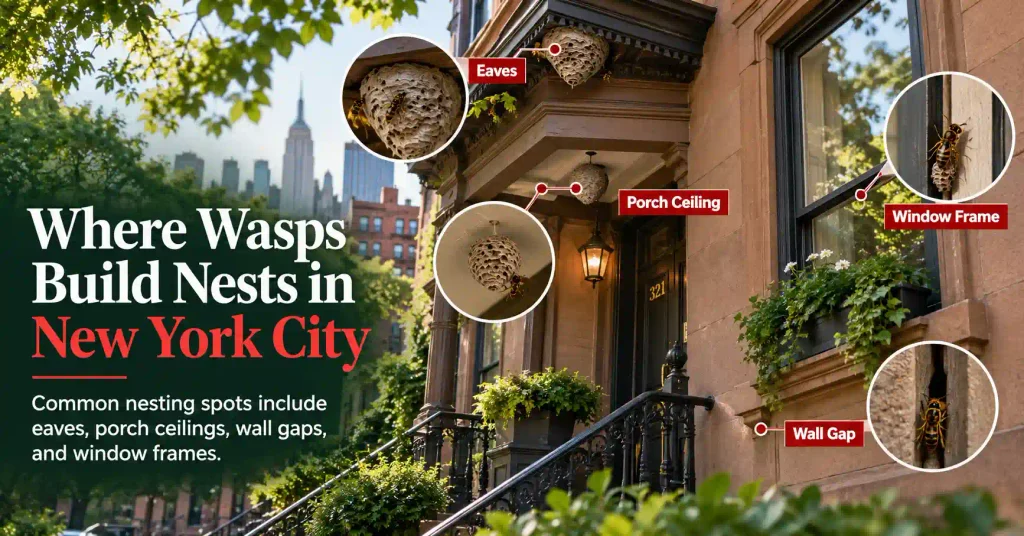
The wasp nesting season can create problems in places that are easy to miss during a quick walk around a property. In New York City, the combination of older buildings, roof gaps, wall penetrations, decks, yards, alley spaces, trees, and dense commercial structures provides many protected nesting opportunities.
A typical wasp nest NYC concern may involve activity around eaves, soffits, exterior trim, attic spaces, roof gaps, wall voids, window areas, sheds, decks, fences, shrubs, trees, or underground cavities. NYC Health lists eaves, wall voids, attic ceilings, bushes, shrubs, building structures, and underground locations among common nesting sites.
Underground nests deserve special care because the entrance may look like a small hole in soil, a gap near landscaping, or an old animal burrow. A person mowing, gardening, moving trash, or walking close to the opening may disturb the colony without realizing a nest is present.
Structural nests can be even more complicated. If wasps are entering a crack in brickwork, siding, roofing, flashing, or a utility opening, the visible entrance may not be the actual nest location. Penn State Extension notes that yellowjackets and hornets can occupy wall voids and other cavities, and blocking the wrong opening without addressing the colony can create additional problems.
For more detail on treatment decisions, see How to Safely Remove Wasps before attempting any work near an active nest.
What Wasps in Summer NYC Usually Means for Homeowners
Summer is the growth stage. A nest that contained only a queen and a small number of workers earlier in the year may become much more active within weeks. Homeowners may notice repeated flights beneath an eave, around a deck, through a hole in siding, or into a gap near the roofline.
Do not judge the size of a colony only by the visible nest opening. Hidden yellowjacket nests may be much larger than they appear from outside. Repeated traffic through one small point is often more important than the size of the hole.
Another useful step is to identify whether you are dealing with a wasp, hornet, or bee. Our guide What’s the Difference Between Wasps and Hornets can help you recognize important differences before deciding on the next step.
Why Wasps in Fall NYC Can Feel More Aggressive
Fall does not always mean the problem is already over. In fact, early fall may still bring heavy activity around established colonies. Social wasp nests have had months to grow, and workers may be strongly defensive close to the nest.
At the same time, late-season workers often become more noticeable around human food and sugary materials. This can make patios, dumpsters, outdoor dining areas, schoolyards, loading areas, and apartment garbage zones feel busier even if the nest is not immediately visible.
If you are asking when wasp season ends in NYC, the answer depends on weather. Colony activity generally declines as temperatures fall, and freezing weather ends the annual colony. The nest itself is not typically reused the following year; instead, mated queens overwinter elsewhere and start new nests in spring.
That also answers the common question when wasps go away in NYC. They do not disappear on a single date. Activity usually falls with colder weather, while sheltered queens survive the winter in separate protected locations.
How Weather Can Change Wasp Activity in NYC
Seasonal timing is shaped by temperature. A warm spring may bring earlier queen activity, while cooler conditions can slow insect movement and colony development. Warm late-summer or early-fall weather can also keep workers active longer.
Urban heat can add another layer. Dense buildings, paved areas, rooftop spaces, and sheltered structural voids may create localized conditions that differ from open suburban landscapes. For that reason, a property owner should use the calendar as a guide, not as proof that a nest is inactive.
The safest rule is simple: if workers are still flying in and out of an opening, treat the location as active.
Residential Properties: What Homeowners and Landlords Should Watch
Homes, brownstones, townhouses, apartment buildings, and multifamily properties can all support wasp nesting. Eaves, attic vents, roof edges, wall gaps, deck spaces, shrubs, and ground cavities should receive extra attention from spring onward.
NYC Health states that residential and commercial property owners are responsible for eliminating nuisance wasps on their property and says nest removal should be handled by a licensed pest control operator.
If an active colony is close to a doorway, balcony, children’s play area, shared walkway, mail area, or trash storage space, delaying action can increase the chance of a sting incident.
For nests that are already established, Wasp Removal Services nyc may be the safer path when access is difficult, the species is uncertain, or the colony is hidden inside a structure.
Commercial Properties Need Earlier Monitoring
Commercial properties face a different type of risk because people may pass through the same area throughout the day. Restaurants, cafés, warehouses, offices, schools, retail stores, multifamily buildings, healthcare facilities, and property management sites may have repeated food, waste, loading, and delivery activity.
That makes routine inspection useful before late summer. Watch rooflines, awnings, eaves, service doors, loading docks, landscaped areas, waste enclosures, exterior utility penetrations, and outdoor seating.
A single active nest near a customer entrance can create a larger operational problem than the same nest in an unused corner of a private yard. Commercial managers should document where workers are seen, how often activity occurs, and whether the traffic appears to lead to a specific opening.
NYC Health recommends an IPM approach for building owners and managers, including professional pest management, proper waste storage, and repair of holes and cracks rather than relying only on routine pesticide spraying.
Should You Remove a Wasp Nest Yourself?
A very small, newly forming nest may seem manageable, but risk changes quickly as a colony grows. If a nest is large, hidden, high above ground, underground, or located inside a wall, attic, roofline, or other structural cavity, DIY removal can trigger defensive activity.
NYC Health is direct on this point: trying to remove a nest yourself is dangerous, and nest removal should be handled by a licensed pest control operator.
If you are researching How to Remove Wasp Nest Safely, remember that “safe” depends on species, nest size, nest location, access, nearby people, and the tools or products being used. A method that might be reasonable for an early exposed nest may not be appropriate for a mature yellowjacket colony inside a wall.
Stinging insects can also be a medical risk. New York State health guidance notes that bites and stings can cause life-threatening allergic reactions in some people. Difficulty breathing after a sting is an emergency that requires immediate medical help.
When Professional Wasp Control Makes Sense
Searches for wasp nest removal NYC often happen after a property owner has already found a nest. At that point, the most important questions are not just how large the visible nest looks, but where the colony is located and how people are using the surrounding space.
A wasp exterminator NYC service may be appropriate when there is steady traffic into a wall gap, an underground nest near a walkway, an aerial nest close to doors or windows, repeated stings, activity inside occupied rooms, or a nest that cannot be reached without a ladder or structural work.
For hidden colonies, professional wasp removal NYC can also reduce the risk of treating only the entrance while leaving the main colony deeper inside a void. Depending on the situation, inspection may include locating the activity source, identifying the species, selecting an appropriate treatment method, and advising on exclusion after the colony is no longer active.
New York State regulates commercial pesticide work. NYSDEC requires pesticide businesses providing commercial applications for hire to be registered, and structural and stinging-insect work falls within commercial pesticide certification categories.
Best@Pest Exterminating can help NYC property owners assess visible activity, locate likely nesting areas, and choose a practical treatment plan based on the property and level of risk.
How to Reduce Wasp Problems Before Peak Season
The best time to think about prevention is before a colony reaches full size. Spring and early summer inspections can reveal small nests, repeated queen activity, and structural openings that may become nesting sites.
Seal accessible cracks and gaps around rooflines, siding, soffits, vents, utility penetrations, and exterior trim where appropriate. Repair damaged screens. Keep exterior garbage containers closed. Clean sugary spills around recycling. Pick up fallen fruit where practical. Avoid leaving pet food outdoors for long periods.
Cornell IPM recommends monitoring buildings and grounds through the warm season, reducing food and trash attraction, noting nest locations, and sealing entryways used to access wall voids after the threat is gone.
If the insects are actually bees, the response may be different. Review Bee Control in NYC for species-appropriate options rather than treating every flying insect as a wasp.
Similarly, How to Remove Bees should be approached with proper identification first, because honey bees, bumblebees, carpenter bees, paper wasps, and yellowjackets do not all require the same control method.
When Is Wasp Season in NYC? Signs You Should Act Instead of Waiting
Some outdoor wasp activity is normal. Wasps are predators and can play a useful ecological role. The problem is usually location, not simply the presence of an insect.
Action becomes more important when you see a steady stream entering one hole, a nest near a doorway, repeated wasps inside a building, ground activity beside a walkway, aggressive defense near a nest, or activity around a place used by children, customers, employees, residents, or pets.
If people can avoid the nest completely, the risk may be lower. But if the nest is built into a high-traffic area, waiting for cold weather may not be practical.
The question When Is Wasp Season in NYC? is therefore useful for planning, but the condition of your property matters more than the date. A small spring nest and a mature September nest are very different problems.
FAQs About Wasp Season in New York City
1. What month do wasps usually start appearing in NYC?
Queens can become active during warmer spring weather, and colony activity builds as temperatures rise. For many social wasps, noticeable activity increases from late spring into summer. Eastern Yellowjackets in the Northeast are commonly active from May through September, although local weather can shift the timing.
2. What months are usually the worst for wasps in NYC?
Late summer and early fall are often the most noticeable period because colonies have had time to grow and more workers are searching for food. August and September can be especially active around trash, outdoor dining, sweet drinks, fruit, and other food sources. The exact peak varies by species and weather.
3. Will a wasp nest die on its own in winter?
Social wasp colonies are annual. Freezing weather kills the old queen, workers, and males, while newly mated queens overwinter elsewhere and begin new nests the next spring. Old nests are generally not reused.
4. Why are wasps going into a hole in my wall?
Repeated entry into one structural opening can indicate a nest in a wall void, attic area, roof space, or another hidden cavity. Do not immediately seal an active entrance if you have not located and addressed the colony. A professional inspection can help determine where the nest is and how to treat it safely.
5. Are yellowjackets more dangerous than paper wasps?
Both can sting, but risk depends on species, nest location, colony size, and whether the nest is disturbed. Yellowjackets can form large colonies and may nest underground or inside structures, making them easy to disturb accidentally. Paper wasp nests are often more exposed and visible. The safest response is to identify the insect and avoid approaching an active nest.
6. When should I call a professional for a wasp problem?
Call for help when a nest is near a high-traffic area, hidden inside a structure, underground near people, high above ground, difficult to identify, or associated with repeated indoor activity or stings. NYC Health advises contacting a licensed pest control operator for nest removal.
Plan Ahead for NYC Wasp Season
For property owners asking When Is Wasp Season in NYC?, the key is to think ahead. Start watching for queen activity and small nests in spring, inspect common nesting areas through summer, and take late-summer activity seriously when repeated worker traffic points to an established colony. If a nest is hidden, large, difficult to reach, or close to residents, employees, customers, children, or pets, avoid disturbing it. Contact Best@Pest Exterminating for a professional inspection and a practical wasp-control plan for your NYC residential or commercial property.